
Why Human CPAs Still Matter in the Age of AI Accounting

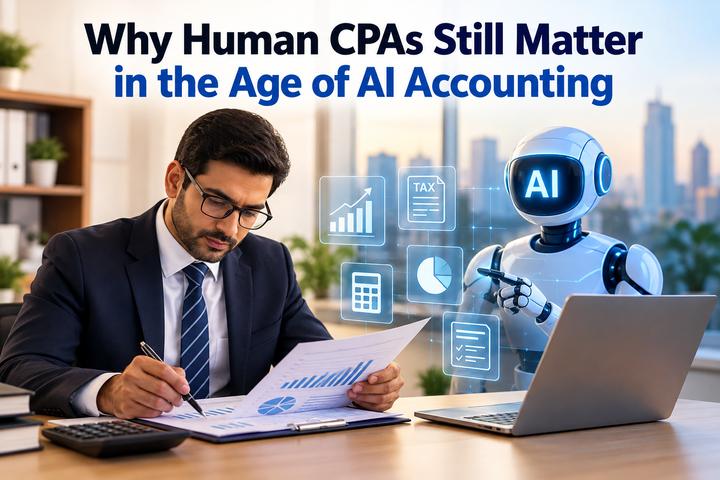
Artificial intelligence is changing the way businesses manage their finances. Tasks that once took hours, such as entering transactions, categorizing expenses, reconciling bank accounts, and preparing financial reports, can now be completed much faster with the help of accounting software and AI-powered tools.
For business owners, this technology offers clear advantages. It saves time, reduces repetitive work, and provides faster access to financial information. However, as accounting technology continues to advance, one important question remains: Can AI replace a human CPA?
The answer is no, not entirely.
While AI can help automate accounting processes, it cannot fully replace the professional judgment, business understanding, ethical responsibility, and personalized financial guidance that an experienced Certified Public Accountant (CPA) provides.
For businesses that want more than basic bookkeeping, the combination of modern accounting technology and human expertise remains essential.
How AI Is Changing the Accounting Industry
AI-powered accounting tools are making financial management more efficient. Many businesses now use cloud-based accounting software and automation tools to handle routine financial tasks.
Some of the most common applications of AI in accounting include:
-
Automated bookkeeping: AI tools can categorize transactions, record expenses, and organize financial information.
-
Bank reconciliation: Accounting software can match bank transactions with recorded entries and identify potential discrepancies.
-
Financial reporting: Businesses can generate profit and loss statements, balance sheets, and cash flow reports more quickly.
-
Expense management: AI can extract information from receipts and invoices, helping businesses maintain organized records.
-
Fraud detection: Certain systems can flag unusual transactions or suspicious patterns for further review.
-
Data analysis: AI can identify financial trends and help business owners understand changes in revenue and expenses.
These capabilities are valuable, particularly for small and midsize businesses that want to improve efficiency without increasing administrative costs.
However, automation works best when the underlying information is accurate, the software is configured correctly, and someone with the right expertise reviews the results.
That is where a human CPA continues to play an important role.
AI Can Process Numbers, but Human CPAs Understand the Bigger Picture
Accounting is not simply about entering transactions and producing reports. Financial information must be interpreted in the context of a company's operations, industry, business goals, and financial position.
For example, an AI accounting tool might identify a significant increase in expenses compared with the previous quarter. It may highlight the difference, but a business owner may need help understanding what caused the increase and what should be done about it.
An experienced CPA can investigate whether the increase resulted from higher operating costs, additional employees, a new business location, an equipment purchase, or an unusual one-time expense.
The CPA can then help management determine whether the change is a concern or a necessary investment in future growth.
Numbers tell a story, but understanding that story requires professional judgment.
Human CPAs bring practical experience and business knowledge that help turn financial reports into meaningful decisions.
Tax Planning Requires More Than Automated Calculations
Tax preparation software can calculate tax liabilities and help organize information. However, tax planning involves much more than completing forms or applying standard calculations.
Businesses must consider applicable federal, state, and local tax rules, changing regulations, available deductions, estimated tax payments, and the tax consequences of important financial decisions.
For example, a business planning to purchase equipment, hire employees, expand into another state, or establish a new legal entity may face several tax considerations.
An AI tool may provide general information, but a CPA can evaluate the business's specific circumstances, review supporting documents, and help determine which options are appropriate under current tax law.
For individuals and business owners with more complex financial situations, professional guidance is particularly important.
A qualified CPA can also help identify potential compliance issues before they become costly problems.
Financial Data Needs Human Review and Accountability
AI systems depend on the information they receive. If the source data is incomplete, incorrectly categorized, or inconsistent, the resulting reports may also be inaccurate.
An automated accounting system might classify a transaction incorrectly, overlook a missing document, or flag a legitimate expense as unusual. In other situations, it may fail to recognize an error that requires closer examination.
A human CPA can review the underlying records, ask questions, examine supporting documentation, and investigate discrepancies.
This is especially important when preparing financial statements, tax returns, audit documentation, and reports used by lenders, investors, or other stakeholders.
Human oversight also helps businesses establish appropriate internal controls and maintain reliable financial records.
AI can assist with identifying problems, but businesses still need qualified professionals to evaluate findings and determine the appropriate response.
Auditing Requires Professional Skepticism
Auditing is one area where human expertise remains especially important.
Audit professionals do more than compare figures or check whether transactions match. They assess risks, evaluate evidence, understand internal controls, investigate unusual activity, and apply professional skepticism throughout the engagement.
AI tools can support these activities by analyzing large volumes of transactions, identifying anomalies, and helping auditors focus their attention on higher-risk areas.
However, an unusual transaction does not automatically indicate fraud, and a transaction that appears normal does not necessarily mean it is free from error.
Auditors must evaluate the evidence, consider the circumstances, and determine whether additional procedures are necessary.
Human judgment remains essential when interpreting findings, communicating with management, and reaching appropriate conclusions under applicable auditing standards.
For businesses that require independent audits, assurance services, or specialized compliance support, technology is a useful resource, but it is not a substitute for qualified professionals.
Every Business Has Different Financial Needs
Accounting software often provides standardized workflows, dashboards, and reports. These features are helpful, but businesses do not all operate in the same way.
A construction company may need help with job costing, contract revenue, and project profitability. A nonprofit organization may need to track restricted funds and meet grant reporting requirements. A real estate investor may need guidance on rental income, depreciation, property expenses, and tax planning.
Similarly, a growing startup may require support with cash flow forecasting, budgeting, and financial planning before making significant investments.
A human CPA can understand these differences and tailor financial guidance to the business.
Rather than simply explaining what happened in the previous month, a CPA can help management evaluate what the numbers mean for the months and years ahead.
This personalized approach can be particularly valuable when a business faces a major financial decision.
Confidentiality, Ethics, and Trust Still Matter
Financial records contain sensitive information about a company's operations, employees, customers, owners, and investors.
Using AI accounting tools requires businesses to consider data security, access controls, confidentiality, and the terms under which their information is processed or stored.
Human CPAs also have professional and legal responsibilities relating to confidentiality, ethics, and the quality of their work. Their specific obligations depend on the services they provide and the rules applicable to their profession.
A trusted CPA can discuss financial concerns, explain the reasoning behind recommendations, answer follow-up questions, and help business owners understand the risks associated with different decisions.
AI-generated information should also be reviewed carefully, especially when it relates to tax compliance, financial reporting, or other matters with significant consequences.
Technology can support the decision-making process, but accountability and informed professional judgment remain important.
AI Makes CPAs More Efficient, Not Less Valuable
The discussion about AI and accounting is often presented as a choice between automation and human professionals. In practice, the two can work together.
AI can reduce the time spent on repetitive administrative tasks, allowing CPAs to focus more attention on analysis, planning, compliance, and client communication.
For example, an accounting team may use automation to organize transactions and reconcile accounts. The CPA can then review unusual items, assess financial performance, and discuss opportunities for improving profitability with the business owner.
This combination can lead to a more efficient accounting process and a more useful client experience.
As technology advances, the role of a CPA may continue to evolve. Professionals who understand both accounting principles and modern technology will be well positioned to help businesses navigate changing financial requirements.
The goal is not to avoid AI. It is to use it responsibly while maintaining the human expertise necessary to produce reliable results.
The Future of Accounting: Technology With a Human Touch
AI will continue to change how accounting work is performed. Routine tasks will become increasingly automated, financial analysis will become more accessible, and businesses will have more tools to manage their money.
However, technology alone cannot guarantee that financial records are accurate, tax decisions are appropriate, or business strategies are sound.
Human CPAs provide the judgment, experience, accountability, and personal guidance needed to interpret financial information and apply it to real-world situations.
For business owners, the most effective approach is not to choose between AI and a CPA. It is to combine the efficiency of technology with the expertise of a qualified professional.
AI can help process the numbers. A human CPA helps you understand them, act on them, and plan for what comes next.
If your business needs reliable accounting, tax planning, audit, or financial advisory support, contact Braj Aggarwal CPA, P.C. to discuss how our team can help.
Frequently Asked Questions (FAQs)
Can AI replace human CPAs in the future?
AI is likely to automate more routine accounting tasks, including data entry, transaction categorization, and certain reporting activities. However, complex tax planning, professional judgment, auditing, business advisory services, and client-specific decision-making continue to require qualified human expertise. The accounting profession is more likely to evolve through collaboration between AI and CPAs than through complete replacement.
What accounting tasks can AI automate?
Depending on the software and how it is configured, AI can assist with bookkeeping, bank reconciliation, invoice processing, expense categorization, financial report preparation, and identifying unusual transactions. Results should be reviewed by a qualified professional when accuracy, compliance, or significant financial decisions are involved.
Why should a small business hire a CPA if it already uses accounting software?
Accounting software helps organize financial information, but it does not automatically ensure that the information is correct or that the business is meeting all applicable tax and reporting requirements. A CPA can review records, assist with tax planning, explain financial performance, identify potential issues, and help the business make informed decisions.
Is AI accounting software accurate and reliable?
AI accounting software can be useful, but its reliability depends on the quality of the source data, the software's capabilities, system configuration, and the complexity of the task. Errors can occur, and AI-generated explanations may be incomplete or incorrect. Regular reviews, appropriate internal controls, and professional oversight help improve reliability.
How can Braj Aggarwal CPA, P.C. help businesses using AI accounting tools?
Braj Aggarwal CPA, P.C. provides bookkeeping, accounting, tax preparation and planning, audit and assurance, virtual CFO, and other specialized accounting services. Our team can help businesses maintain reliable records, review financial information, address tax and compliance requirements, and use accounting technology as part of a broader financial management strategy.
How Braj Aggarwal CPA, P.C. Can Help Your Business
At Braj Aggarwal CPA, P.C., we understand that effective accounting involves more than maintaining records or preparing tax returns. Business owners need accurate financial information, practical guidance, and support in making decisions that affect their company's future.
Our team provides accounting, tax, audit, and financial advisory services to help businesses manage their financial responsibilities and plan for growth.
Whether your business is already using AI accounting software or considering automation for the first time, professional oversight can help you get more value from your financial systems.
Our services include:
Bookkeeping and Accounting Services
We help businesses maintain organized financial records, reconcile accounts, review transactions, and prepare financial reports that support day-to-day management and informed decision-making.
Our team assists businesses and individuals with tax preparation, tax planning, and evaluating tax considerations associated with business operations and financial decisions.
We provide audit and assurance services designed to address applicable reporting requirements and help clients navigate their financial reporting responsibilities.
Businesses that need financial guidance beyond routine accounting can benefit from budgeting, cash flow analysis, financial forecasting, and strategic financial support.
Forensic Accounting and Specialized Compliance Support
Where appropriate, we assist with specialized accounting matters that require detailed financial analysis, investigation, or compliance-focused expertise.
We help business owners evaluate financial performance, understand important accounting issues, and identify areas where better financial management may support business objectives.
By combining professional accounting knowledge with appropriate technology, we help clients focus on what matters most: maintaining financial clarity, meeting their obligations, and making informed business decisions.
If you are looking for an accounting partner who understands both the technical side of finance and the practical challenges of running a business, Braj Aggarwal CPA, P.C. can help you identify the right level of support for your needs.