
Bookkeeping for Trucking Companies: Complete Guide

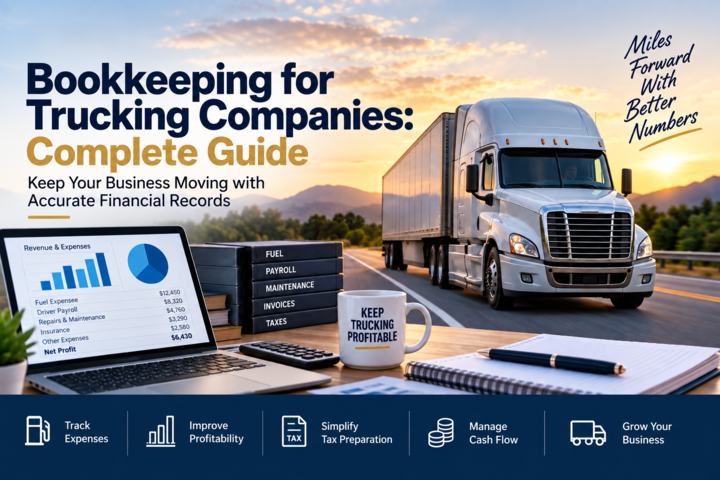
Running a trucking company involves much more than moving freight from one location to another. Trucking business owners have to manage drivers, fuel expenses, truck maintenance, insurance, tolls, permits, repairs, payroll, freight payments, factoring, and many other day-to-day costs.
With so many financial transactions taking place every week, accurate bookkeeping is essential for understanding the financial health of your trucking business. Proper bookkeeping can help you track profitability, control expenses, manage cash flow, prepare accurate tax returns, and make better business decisions.
In this complete guide, we explain everything trucking companies should know about bookkeeping, including common expenses, accounting challenges, financial reports, tax considerations, and how professional trucking bookkeeping services can help.
What Is Bookkeeping for a Trucking Company?
Bookkeeping is the process of recording, organizing, categorizing, and reconciling the financial transactions of your trucking business.
For a trucking company, bookkeeping typically includes tracking:
- Freight and transportation revenue
- Fuel purchases
- Driver wages and payroll
- Truck and trailer payments
- Truck repairs and maintenance
- Commercial auto insurance
- Tolls and road expenses
- Permits and registration fees
- Factoring fees
- Dispatching expenses
- Lease payments
- Parking expenses
- Office expenses
- Professional fees
- Loan and interest payments
- Depreciation
- Accounts receivable and accounts payable
Unlike ordinary businesses, trucking companies often have large numbers of transactions spread across multiple trucks, drivers, routes, vendors, and customers. This makes organized bookkeeping particularly important.
Why Is Bookkeeping Important for Trucking Companies?
Accurate bookkeeping gives trucking business owners a clear picture of where their money is coming from and where it is going.
1. Understand Your Trucking Business Profitability
Revenue alone does not tell you whether your trucking company is profitable.
A company may generate significant freight revenue while spending too much on fuel, repairs, insurance, payroll, truck payments, or other operating expenses.
Proper bookkeeping allows you to compare revenue against expenses and determine your actual profit.
For example, you can analyze:
- Revenue per truck
- Revenue per mile
- Fuel cost per mile
- Maintenance cost per truck
- Driver labor costs
- Operating expenses
- Gross profit
- Net profit
This information can help owners identify which areas of the business are performing well and where costs may need attention.
2. Improve Cash Flow Management
Cash flow is one of the biggest challenges for many trucking businesses.
You may complete a load today but receive payment weeks later. At the same time, fuel, payroll, repairs, insurance, truck payments, and other expenses may need to be paid immediately.
Professional bookkeeping helps you monitor:
- Cash available
- Outstanding invoices
- Customer payments
- Vendor bills
- Upcoming expenses
- Loan payments
- Payroll obligations
Better visibility into cash flow can help trucking companies plan for future expenses and avoid unexpected cash shortages.
3. Make Tax Preparation Easier
Trucking companies have numerous deductible business expenses. However, those deductions are only useful when expenses are properly recorded and supported by appropriate documentation.
Organized bookkeeping provides your CPA or tax professional with accurate financial records needed for tax preparation.
Depending on the company's circumstances, bookkeeping may help track expenses related to:
- Fuel
- Repairs
- Maintenance
- Insurance
- Depreciation
- Interest
- Tolls
- Supplies
- Office expenses
- Professional services
- Employee-related costs
- Business travel
Tax treatment can vary based on the specific facts of your business, so trucking companies should work with a qualified tax professional before claiming deductions.
Common Bookkeeping Challenges for Trucking Companies
Trucking businesses face accounting challenges that are different from many other industries.
Fuel Expense Tracking
Fuel is often one of the largest operating expenses for a trucking company.
Businesses may purchase fuel using fuel cards, credit cards, cash, or other payment methods. Without proper reconciliation, duplicate or missing transactions can occur.
A good bookkeeping system should organize fuel transactions and allow owners to analyze fuel spending by truck, driver, or operating period when useful.
Repairs and Maintenance
Trucks require regular maintenance and can also experience unexpected breakdowns.
Bookkeeping should properly distinguish between routine repairs, maintenance expenses, and larger expenditures that may need different accounting treatment.
Maintaining detailed records can help management understand the maintenance cost associated with each truck.
Driver Payroll
Driver compensation can include:
- Regular wages
- Mileage-based pay
- Bonuses
- Per diem arrangements
- Other compensation
Payroll records should be accurately integrated into the company's accounting system.
Factoring Transactions
Many trucking companies use freight factoring to improve cash flow.
Factoring transactions can make bookkeeping more complicated because the accounting records need to reflect invoices, advances, fees, and amounts received.
Proper reconciliation is important to ensure that factoring activity is accurately reflected in the books.
Multiple Trucks
As a trucking company grows from one truck to multiple trucks, bookkeeping becomes increasingly complex.
Owners may want to know which trucks are generating revenue and which trucks are generating excessive expenses.
Maintaining appropriate accounting records can support truck-level or business-segment analysis.
Essential Accounts for a Trucking Company
A trucking company's chart of accounts should be designed around its actual operations.
Typical revenue accounts may include:
- Freight Revenue
- Transportation Revenue
- Dedicated Contract Revenue
- Other Operating Revenue
Common expense accounts may include:
- Fuel
- Driver Wages
- Payroll Taxes
- Truck Repairs
- Truck Maintenance
- Tires
- Insurance
- Tolls
- Permits
- Truck Lease Payments
- Loan Interest
- Parking
- Dispatch Fees
- Factoring Fees
- Accounting Fees
- Legal Fees
- Office Expenses
- Software and Technology
- Telephone and Internet
The exact chart of accounts should be customized to the trucking company's structure and reporting needs.
Important Financial Reports for Trucking Companies
A professional bookkeeping system should produce reliable financial reports.
Profit and Loss Statement
The Profit and Loss Statement shows the company's revenue, expenses, and net income for a specific period.
Trucking owners can use it to evaluate:
- Total freight revenue
- Operating expenses
- Gross profit
- Net income
- Changes in expenses
Balance Sheet
The Balance Sheet provides a snapshot of the company's financial position.
It generally includes:
Assets
- Cash
- Accounts receivable
- Trucks
- Trailers
- Equipment
Liabilities
- Truck loans
- Equipment loans
- Accounts payable
- Credit card balances
Equity
- Owner's investment
- Retained earnings
- Current-year income
Cash Flow Statement
A Cash Flow Statement helps business owners understand how cash moves through the company.
This can be particularly useful for trucking companies because revenue recognition and actual cash collection may occur at different times.
Bookkeeping Software for Trucking Companies
Many trucking companies use accounting software such as QuickBooks Online or other transportation-focused accounting systems.
The software can help with:
- Income tracking
- Expense categorization
- Bank reconciliation
- Accounts receivable
- Accounts payable
- Financial reporting
- Payroll integration
- Receipt management
However, accounting software does not eliminate the need for proper bookkeeping.
Incorrect account classifications, unreconciled bank accounts, duplicate transactions, or improperly recorded factoring transactions can result in inaccurate financial statements.
The quality of the accounting records depends heavily on how the system is configured and maintained.
Bank Reconciliation for Trucking Businesses
Bank reconciliation is an important part of bookkeeping.
The process involves comparing transactions recorded in the accounting system with the company's bank and credit-card statements.
Regular reconciliation can help identify:
- Missing transactions
- Duplicate transactions
- Incorrect amounts
- Unrecorded fees
- Unauthorized transactions
- Timing differences
For trucking companies with many transactions every month, regular reconciliation can significantly improve the reliability of financial records.
Accounts Receivable Management
Trucking companies often provide services before receiving payment.
Accounts receivable bookkeeping helps track:
- Customer invoices
- Invoice dates
- Payment terms
- Outstanding balances
- Past-due invoices
- Customer payments
A well-maintained accounts receivable system helps owners understand how much money customers owe the company and when those amounts are expected to be collected.
Accounts Payable Management
Trucking businesses also have many vendors and recurring expenses.
Accounts payable may include:
- Repair shops
- Fuel vendors
- Insurance providers
- Leasing companies
- Parts suppliers
- Dispatch services
- Technology providers
- Professional service providers
Proper accounts payable records help businesses avoid missed payments and provide a clearer picture of upcoming financial obligations.
Mileage and IFTA Records
Interstate trucking businesses may have additional compliance and recordkeeping requirements.
The International Fuel Tax Agreement (IFTA) applies to qualifying motor carriers operating across participating jurisdictions.
Accurate records may be needed to support calculations involving:
- Miles traveled
- Fuel purchased
- Jurisdictional activity
- Fuel consumption
Trucking companies should maintain appropriate mileage and fuel records and work with qualified professionals regarding their specific IFTA filing obligations.
Tax Considerations for Trucking Companies
Tax planning is an important part of trucking business management.
Depending on the business structure and circumstances, trucking companies may have federal, state, and local tax obligations.
Potential areas may include:
- Federal income tax
- State income tax
- Payroll taxes
- Sales and use tax where applicable
- Highway use taxes
- IFTA-related obligations
- Business registration and filing requirements
Tax rules can be complex and may change. Trucking companies should consult a CPA or qualified tax professional regarding their specific tax situation.
Bookkeeping for Owner-Operators
Owner-operators often manage both driving and business responsibilities.
This can make it difficult to keep financial records current.
An owner-operator may need to track:
- Freight income
- Fuel
- Repairs
- Insurance
- Truck payments
- Tolls
- Permits
- Supplies
- Professional fees
- Business-related travel
- Other operating expenses
Separating personal and business transactions is particularly important.
A dedicated business bank account and business credit card can make bookkeeping and financial reporting significantly easier.
Bookkeeping for Trucking Companies With Multiple Drivers
Growing trucking companies may have multiple drivers, trucks, routes, and customers.
At this stage, management needs more than basic income and expense tracking.
Owners may benefit from reports showing:
- Revenue by truck
- Revenue by customer
- Revenue by route
- Fuel cost by truck
- Maintenance expenses
- Driver payroll
- Operating margin
- Accounts receivable
- Cash flow
These reports can help management make informed operational decisions.
How Often Should a Trucking Company Update Its Books?
Bookkeeping should ideally be performed regularly rather than waiting until tax season.
Depending on transaction volume, a trucking company may choose:
- Weekly bookkeeping
- Biweekly bookkeeping
- Monthly bookkeeping
High-volume trucking companies may benefit from more frequent bookkeeping because management can identify financial issues sooner.
Waiting until the end of the year can make it difficult to understand the company's financial performance while there is still time to make operational or tax-planning decisions.
Common Bookkeeping Mistakes Trucking Companies Should Avoid
Mixing Personal and Business Expenses
Using business accounts for personal expenses can make financial reporting and tax preparation more complicated.
Failing to Reconcile Bank Accounts
Unreconciled accounts can result in inaccurate financial statements.
Poor Expense Categorization
Fuel, repairs, maintenance, insurance, interest, and other expenses should be recorded consistently.
Ignoring Factoring Fees
Factoring fees should be properly recorded so the company understands the true cost of financing its receivables.
Not Tracking Truck-Level Performance
For companies with multiple trucks, looking only at total company revenue may hide underperforming assets.
Waiting Until Tax Season
Year-end bookkeeping can become stressful when months of transactions have not been properly recorded.
Not Keeping Supporting Documents
Receipts, invoices, statements, and other financial documentation should be retained according to applicable recordkeeping requirements.
How Professional Bookkeeping Can Help Trucking Companies
Outsourcing bookkeeping can allow trucking business owners to spend more time managing operations, drivers, customers, and business growth.
A professional bookkeeping provider can help with:
- Recording transactions
- Categorizing expenses
- Bank reconciliation
- Credit-card reconciliation
- Accounts payable
- Accounts receivable
- Financial statements
- Payroll coordination
- Factoring reconciliation
- Monthly bookkeeping
- Expense reporting
- Management reporting
- Tax-ready financial records
Professional bookkeeping can also provide business owners with a consistent financial reporting process.
What Should You Look for in a Trucking Bookkeeping Service?
When selecting a bookkeeping or accounting firm, trucking companies should consider whether the provider understands the industry's financial processes.
Important areas to evaluate include:
- Experience with trucking businesses
- Knowledge of transportation expenses
- Understanding of fuel and mileage records
- Experience with QuickBooks or other accounting software
- Knowledge of factoring transactions
- Payroll experience
- Tax preparation capabilities
- Financial reporting
- Communication and responsiveness
- Ability to support business growth
A bookkeeping provider that understands the trucking industry can help ensure that the accounting system reflects how the business actually operates.
Frequently Asked Questions About Trucking Bookkeeping
What is trucking bookkeeping?
Trucking bookkeeping is the process of recording and organizing the financial transactions of a trucking company, including freight revenue, fuel, repairs, payroll, insurance, truck payments, factoring fees, and other business expenses.
How much does bookkeeping for a trucking company cost?
Bookkeeping costs vary depending on the company's transaction volume, number of trucks, payroll requirements, accounting software, factoring activity, and reporting needs. A bookkeeping provider can generally provide a customized fee based on the scope of services required.
Should trucking companies use QuickBooks?
QuickBooks can be useful for many trucking businesses, particularly when it is properly configured and maintained. The appropriate accounting system depends on the company's size, operations, reporting requirements, and accounting needs.
Do trucking companies need a CPA?
A CPA can provide accounting, tax planning, tax preparation, and financial guidance in addition to bookkeeping support. Whether a trucking company needs a CPA depends on its business structure, complexity, and specific accounting and tax requirements.
What expenses should trucking companies track?
Common trucking expenses include fuel, repairs, maintenance, insurance, payroll, truck payments, lease payments, tolls, permits, tires, factoring fees, dispatching costs, office expenses, and professional fees.
Why is monthly bookkeeping important for trucking companies?
Monthly bookkeeping helps business owners maintain current financial records, monitor profitability, reconcile accounts, track receivables and payables, and prepare more effectively for tax and financial planning.
How Braj Aggarwal, CPA, P.C. Can Help Your Trucking Business
At Braj Aggarwal, CPA, PC, we understand that trucking companies need more than basic data entry. Accurate bookkeeping can provide the financial information business owners need to manage expenses, monitor profitability, improve cash-flow visibility, and prepare for tax filing.
Our accounting professionals can assist trucking businesses with bookkeeping and accounting services tailored to their operations, including transaction recording, account reconciliation, accounts payable and receivable, financial reporting, and tax-ready books.
We can also help trucking business owners organize financial information related to fuel expenses, truck repairs and maintenance, driver-related costs, insurance, truck financing, factoring transactions, and other operating expenses.
Whether you operate as an owner-operator or manage a growing fleet, having accurate and up-to-date books can make it easier to understand your company's financial performance.
If you are looking for professional bookkeeping and accounting support for your trucking company, Braj Aggarwal, CPA, P.C. can help you maintain organized financial records and gain better visibility into your business finances. Contact us to discuss your trucking company's bookkeeping and accounting needs.
Need Help With Your Trucking Company Bookkeeping?
Contact Braj Aggarwal, CPA, P.C. for professional bookkeeping, accounting, payroll, and tax services tailored to trucking businesses.