
The Pass-Through Entity Tax (PTET): A Comprehensive Guide for Business Owners

The Pass-Through Entity Tax (PTET) has become one of the most significant tax planning tools for business owners since the federal Tax Cuts and Jobs Act (TCJA) limited the state and local tax (SALT) deduction to $10,000 per year on individual returns. Today, more than 35 states have enacted some form of PTET, including New York, California, New Jersey, Connecticut, Illinois, Massachusetts, and many others. This article explains what PTET is, provides a practical example, and examines its advantages and disadvantages.
What Is a Pass-Through Entity Tax?
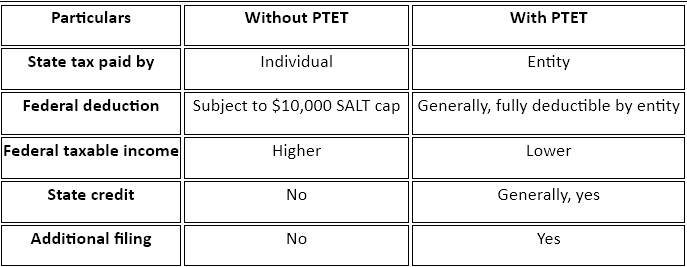
The Pass-Through Entity Tax (PTET) is an optional state-level tax regime that allows certain pass-through entities, such as S Corporations, Partnerships, and LLCs taxed as partnerships or S corporations, to pay state income tax at the entity level rather than at the individual owner level. The core concept is straightforward: instead of owners paying state income tax on their share of business income at the individual level (and being subject to the $10,000 SALT cap), the business itself pays the tax.
In exchange, the owners receive a tax credit on their state personal income tax returns for their share of the PTET paid. Simultaneously, the business gets a federal deduction for the PTET payment as a business expense a deduction not limited by the SALT cap.
Why was PTET Introduced?
Before 2018:
- State income taxes paid by individuals were generally fully deductible on their federal income tax returns as itemized deductions.
After the TCJA:
- Individuals may deduct only up to $10,000 of combined state and local taxes (SALT).
This limitation significantly increased the federal tax burden for owners living in high-tax states.
PTET effectively shifts the state tax payment from the individual to the business entity, allowing the entity to deduct the tax as a business expense for federal income tax purposes.
PTET works as follows:
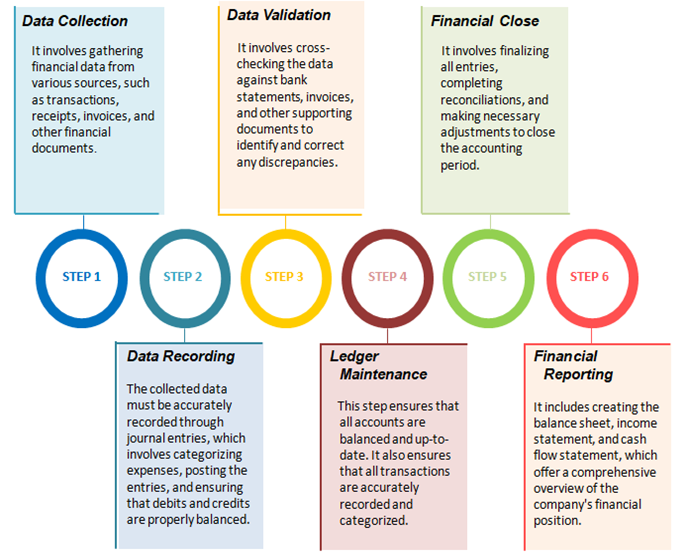
Eligible Entities:
Eligibility varies by state.
Generally eligible entities include:
- S Corporations
- Partnerships
- Multi-member LLCs taxed as partnerships
- LLCs taxed as S Corporations
Generally, not eligible:
- Corporations that are not New York S corporations
- Sole Proprietorships
- Single-member LLCs taxed as disregarded entities
- Non-profit corporations
- trusts
Election of PTET:
Most states require an annual election through the entity's Business Online Services account.
The election generally:
- must be made electronically;
- is irrevocable for that tax year; and
- has a specific due date established by each state.
- Generally, an eligible entity may opt in on or after January 1, but no later than March 15 of that year.
Failure to make a timely election generally results in loss of PTET eligibility for that year.
PTET Tax rates-
PTET rates are not uniform across states. Some states use the individual income tax rate, some have flat rates, and others use graduated rates. In New York State, an electing pass-through entity is subject to PTET at graduated rates ranging from 6.85% to 10.90% on its New York PTE taxable income.
For entities that are eligible for and elect the New York City PTET, an additional tax is imposed at a flat rate of 3.876% on the entity's New York City PTE taxable income attributable to NYC.
Estimated Tax Payments
Most states require estimated PTET payments.
For example:
New York generally requires:
- Annual election.
- Quarterly estimated PTET payments.
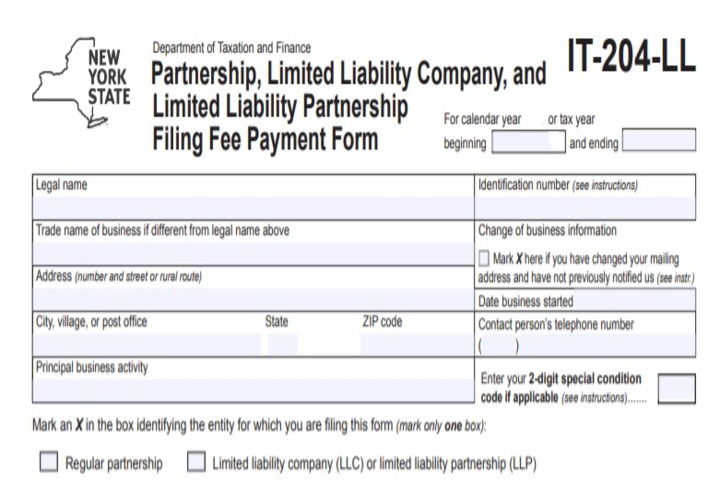
- Annual PTET return.
Each quarterly payment should be an amount equal to at least 25% of the required annual payment for the taxable year. The required annual payment is the lesser of:
- 90% of the PTET shown on the return of the electing entity for the taxable year; or
- 100% of the PTET shown on the return of the electing entity for the preceding taxable year.
Failure to make sufficient estimated payments may result in interest and penalties.
Annual Return
On or before March 15, an electing entity must file an annual PTET return using the online return application to report the information required for the PTET taxable year. PTET returns are filed on a calendar-year basis. An electing entity may make an online request by March 15 for a six-month extension of time to file its annual PTET return. Penalties and interest will apply for late filing of the return or late payments.
On its return, the PTET entity must identify all the entity’s partners, members, or shareholders that are eligible to claim PTET credits.
Reporting information to partners, members, and shareholders
Each electing PTET entity must provide sufficient information to its eligible partners, members, and shareholders to allow them to claim and support the PTET credit on their personal income tax returns.
New York PTET Example
Let us take a situation where ABC Inc. is a New York S Corporation with one New York resident shareholder. During the tax year, the corporation earns $300,000 of taxable business income.
The shareholder is in the 37% federal income tax bracket and already exceeds the $10,000 federal SALT deduction limitation.
Should the corporation elect the New York Pass-Through Entity Tax (PTET)? If so, what would be the federal tax benefit compared to not making the PTET election?
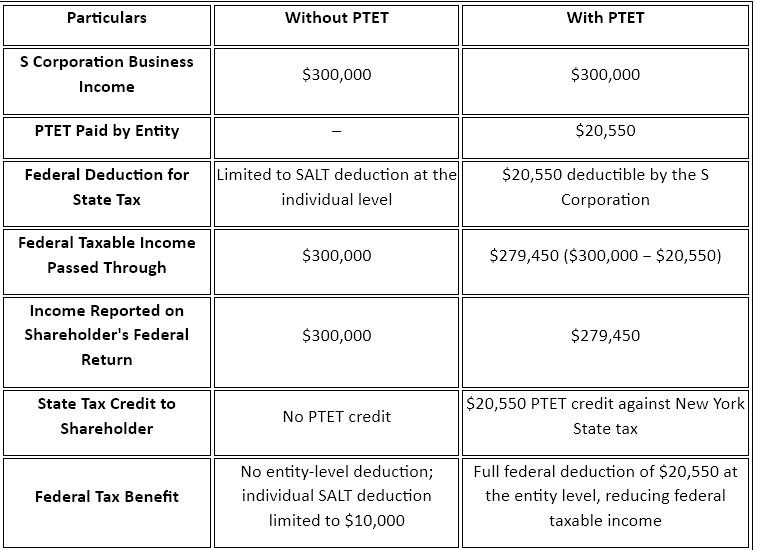
Federal Tax Savings (Illustrative)
Assume the shareholder is in the 37% federal tax bracket:
- PTET Deduction: $20,550
- Estimated Federal Tax Savings: $20,550 × 37% = $7,604
Thus, by electing PTET, the shareholder receives:
- A New York tax credit of $20,550, and
- An estimated federal tax savings of approximately $7,604 due to the entity-level deduction.
This side-by-side comparison clearly demonstrates the principal benefit of PTET: the state tax remains payable, but by shifting the deduction to the entity level, the federal SALT deduction limitation is effectively bypassed, resulting in lower federal taxable income.
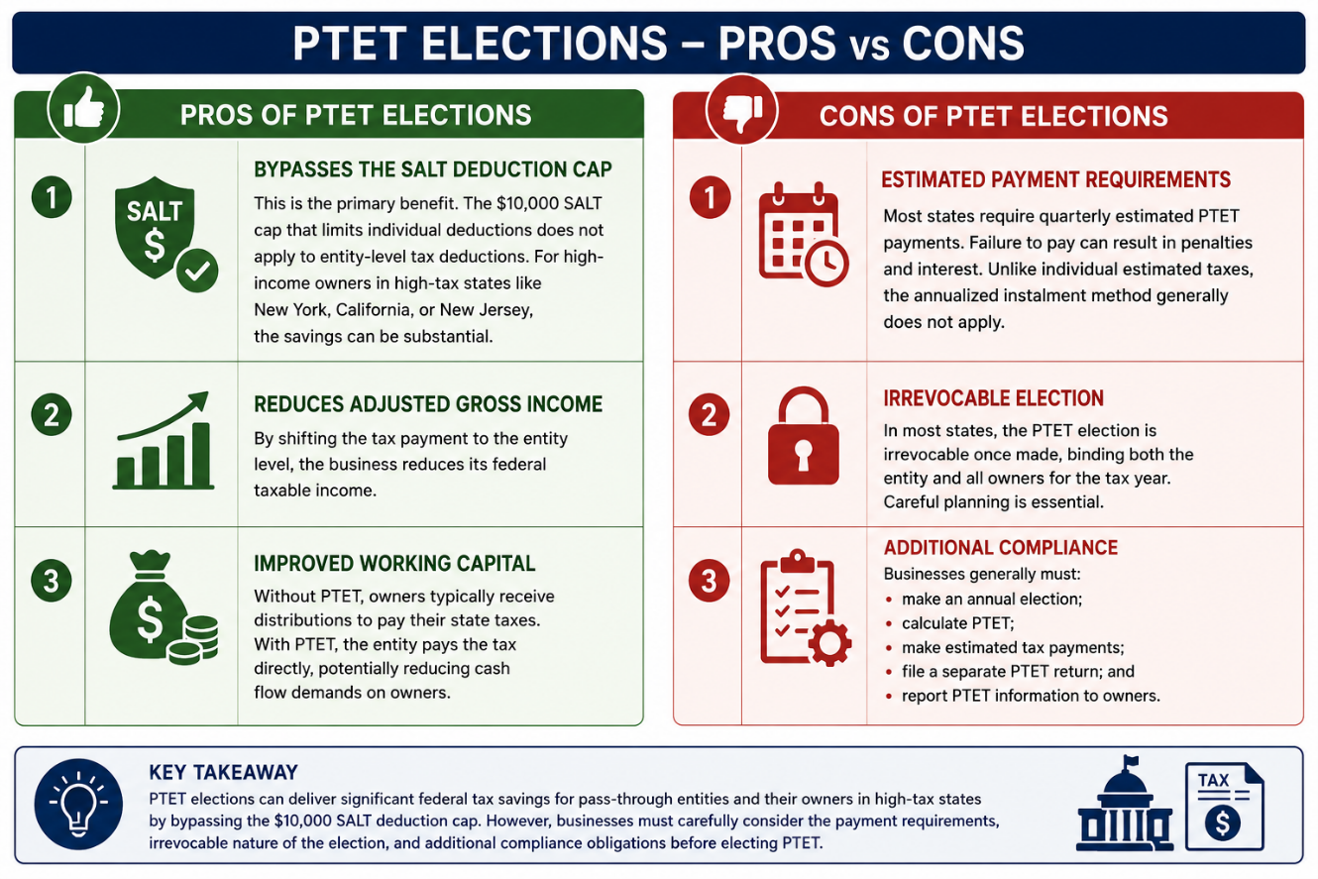
Pros and Cons of PTET Election:
Is PTET Right for Your Business?
A PTET election is generally most beneficial for:
- Profitable S corporations, partnerships and LLCs taxed as partnerships
- businesses operating in high-income-tax states such as New York, California, New Jersey, Massachusetts, and Illinois.
- Owners with high personal income who exceed the SALT cap
- Partnerships with mostly individual (not corporate) owners
PTET may be less beneficial for:
- The entity has recurring losses
- Businesses with owners in states that don't provide resident credits
- Entities with low-income owners who don't exceed the SALT cap
- Businesses with significant corporate or trust owners
PTET vs. Individual State Tax
Conclusion
The PTET represents a strategic workaround to the federal SALT deduction limitation, offering potentially significant tax savings for pass-through entity owners. However, the complexity of state-by-state rules, combined with evolving federal legislation, makes careful, individualized analysis essential. A careful annual review by a tax professional is recommended to determine whether the PTET election is beneficial based on the entity's income, ownership structure, resident states of the owners, and the specific rules of the states in which the business operates.
Braj Aggarwal, CPA, PC can help business owners evaluate the potential benefits and costs of a PTET election and develop a tax strategy based on their specific circumstances. Our team can assist with PTET planning for S corporations, partnerships, and eligible LLCs, including estimating potential tax savings, reviewing ownership and residency considerations, coordinating estimated payments, preparing required tax filings, and ensuring PTET credits are properly reported to eligible owners. We also provide broader business tax planning and tax preparation services to help clients make informed decisions while maintaining compliance with federal, New York State, and applicable local tax requirements. Contact Braj Aggarwal, CPA, PC to discuss whether PTET should be part of your annual tax planning strategy.